
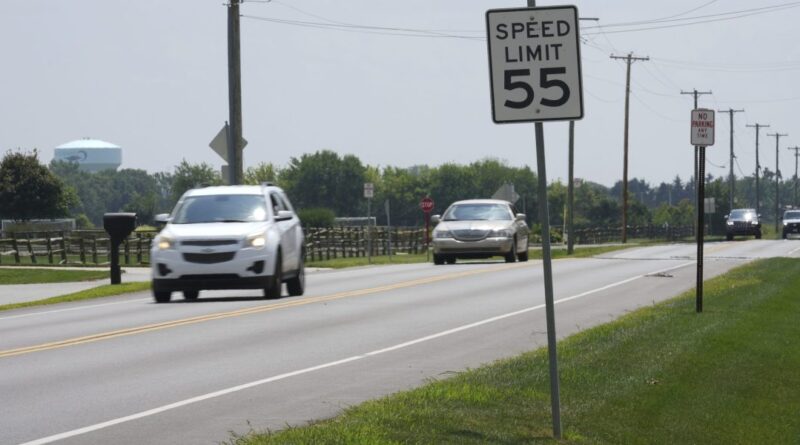
Today’s speed limits grew from studies on rural roads from the 1930s and 1940s. Statistics are now trying to change the instructions
For years, Rose Hammond has pushed the authorities to reduce the speed limit of 55 mph on a two -lane road, which its community assisted by the living, church, two schools and a busy park organized by a number of youth sports league.
“What do you want, someone killed?” The 85 -year -old chased officials in Northwest Ohia and complained that the motorcycles that raced were almost daily.
In the middle of growing public pressure, Sylvania Township asked district engineers in March to analyze the published speed of Whitchaw Road. Surprising answer: Technically too low is 5 mph.
The reason dates back to studying on rural roads from the age of 30 and 40, which still play an excessive role in the way the speed limits are set in the US – even in urban areas.
Of this research, the birth was as 85% of the rule, indicating that the transmitted speed of the road should be a vehicle from the 15th. Finals of every 100 free current passengers, rounded to the next 5 mph increase.
However, after decades of closely monitoring the rule, some states – with nudge from the federal government – are trying to adjust if it does not replace it if the guide, how local engineers should decide what speed limit they will publish.
Drivers set speed
The concept assumes that the safest speed of the road is the most travel vehicle – neither too high nor. If drivers think that the speed limit should be increased, they can simply enter gas and “vote with his feet”, like an old brochure from the Institute of Traffic Engineers.
“The problem with this approval is that it creates this feedback,” said Jenny O’Connell, director of the Member Programs for the National Association of City Transport officials. “People are accelerating, and then the speed limits will grow to match this speed.”
The Association has developed an alternative to 85% of the rule known as the “urban limits”, which aims to minimize the risk of inspectors for all road users by determining the speed limit based on the street activity level and the probability of conflicts such as deductions.
The report points out that the 85% rule is based on the date and that “these historical roads are far from the pulsating streets and arterials that today typize the city streets.”
In the midst of a recent increase in road deaths across the country, the Federal Motorway Administration sent a fine but important report to the states that 85% of the rule is not really the rule at all and carried too much weight in determining local speed limits. In its first update since 2009 on a manual that sets national traffic signs, the agency has explained that communities should also consider things as the road is used, the risk for pedestrians and the frequency of accidents.
Leah Shahum, which controls the Vision Zero Network, the non -profit defense of the street, said that she wanted the manual to go further in reducing 85% of the rules, but acknowledges that the change has an impact on how some states set up. Others, however, still adhere to the simplicity and acquaintance of the long -term approach, she said.
“85. Percentil should not be the Holy Grail or the Bible, and yet it is again and again accepted,” Shahum said.
Re -evaluation of the need for speed
As part of its “20 IS IS Planty” campaign, the capital of Wisconsin in Madison is changing throughout the city this summer and reduces the speed limit from 25 km / h to 20 mph in local residential streets.
When Seattle took a similar step in the pilot program seven years ago, not only a significant decrease in accidents of serious injuries, but also a 7% drop in 85. Percentile speed, in accordance with the vision of zero network.
California includes 85% even more than most states as a basis for setting speed limits. In recent years, the legislators have released a little restrictions on local governments, allowing them to deviate from the guide if they can quote the proven security. Pedestrian and cyclist advocates say that the change is helping, but it is not enough.
“We still have a long way in California when it comes to the value of all road users,” said Kendra Ramsey, Executive Director of the California Coalition on the bike. “There is still very difficult thinking that cars are a primary method of traveling and should have priority and respect.
However, Jay Beber, Executive Director of Policy in National Motorists Association, a lawyer for drivers, said that 85% of the rule is usually the safest way to minimize the speed change among drivers who follow the published limited and those who have been far away.
“It doesn’t matter what issue you give a sign,” Beeber said. “The average driver controls the nature of the road. It would be obviously unfair to put the government a way to encourage people to drive 45 miles / h, put a speed limit of 30 mph on it, and then representing all of them to do what they built the way.”
80 is a new 55
Congress was concerned about the oil prices in the 1970s to determine the national maximum speed limit of 55 mph, which later released at 65 million before abolishing the law in 1995 and handed over the authority to states. The sales of speed limits were still climbing, and Northern Dakota became the ninth state this summer, allowing drivers to go 80 km / h on some sections of the highway. There is even 40 miles of segment between Austin and San Antonio, where 85 mph is allowed.
Although high-speed highways outside the main population centers are not the subject of most efforts to alleviate 85% of the rules, a study from 2019 from the insurance institute for highway safety-research shoulder funded by authorial illustrations. The study found that every 5 MPH increases the maximum speed limit of the state maximum speed increases the chance of death by 8.5% and 2.8% on other roads.
“Maybe when you were driving the T model, you had a real feeling how fast you went, but in modern vehicles you feel what is 80 mph. You are in a cocoon,” said Chuck Farmer, vice president of the institute research that brought the study.
An attempt to change a change
If elected officials in the black district of Sylvania in Ohio were given a way, sent by Mitchaw Road’s speed limit would be dramatically reduced – from 55 km / h to 40 mph or lower. The finding of the region that 85% of the rule actually requires to increase it to 60 mph, surprise the city leader, but not the engineers who conducted the study.
“If we decide on the basis of data, it is very difficult to make good decisions,” said Lucas Mike Pneiwski.
Meanwhile, the speed limit will be as it is. This is because Ohio Law determines maximum speeds for 15 different types of roads, no matter what 85% of the rule indicates.
And Ohio’s instructions develop. The state will now consider the context of the road and allow cities to reduce speed limits based on a lower standard of 50. Percential speed if there is a large presence of pedestrians and cyclists. The authorities have recently hired a consultation to bending adjustments about what other states are doing.
“The states began to move 85 very slowly. The percentile as a kind of gold standard for decision -making,” said Michelle May, who Tales Ohio is a highway security program. “People travel and live differently than 40 years ago and we want to focus more.”
It is not clear where some of these changes affect the ultimatals impact on the published speed on Mitchaw Road. After years of futile calls AE -mails for state, regional and black officials, Hammond says he does not hold his breath.
“He just discourages me,” she said.
(Tagstotranslate) Autos